
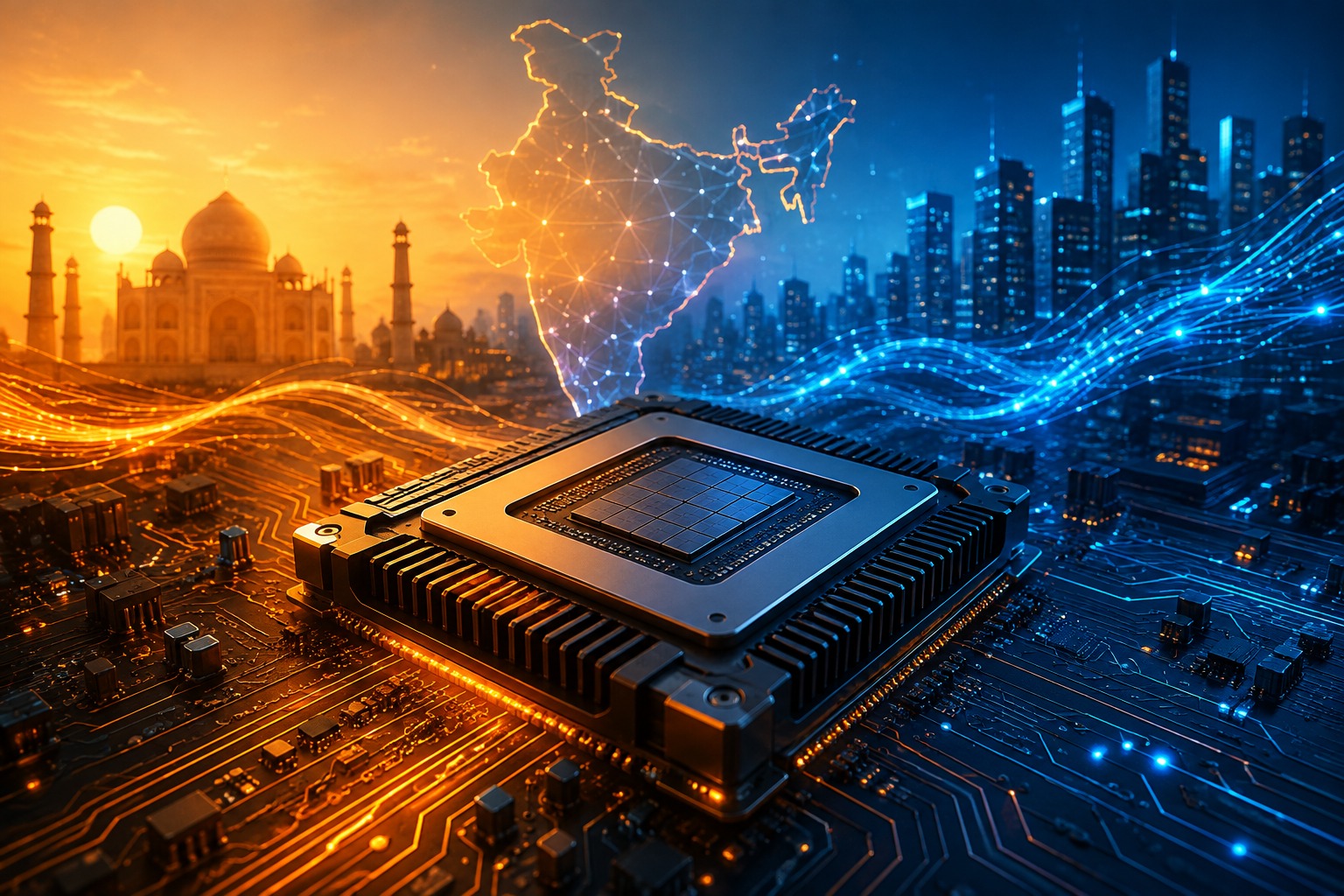

Can India become an AI superpower if the most important hardware powering its AI ecosystem is designed and controlled elsewhere?
Artificial Intelligence is rapidly becoming one of the most important technologies shaping the global economy. From healthcare and defence to agriculture, manufacturing, finance and education, AI is moving from research laboratories into everyday infrastructure.
India is already building a significant AI ecosystem. Under the IndiaAI Mission, the country has been expanding access to high-performance computing, with more than 38,000 GPUs onboarded through the IndiaAI Compute Portal by March 2026. These resources are being made available to startups, researchers and academia at subsidised rates.
Who makes the chips that power India’s AI ambitions?
That is why developing an Indian GPU or AI accelerator ecosystem deserves serious national attention.
AI Sovereignty Starts With Compute
When people talk about AI sovereignty, they usually focus on data, algorithms and AI models.
But there is another essential layer:
Compute.
Training and running sophisticated AI models requires enormous computing power. The more powerful the model, the greater the demand for processors, high-bandwidth memory, networking and data-centre infrastructure.
India’s AI strategy is already investing heavily in this area. The IndiaAI Mission was approved with an outlay of approximately ₹10,372 crore, including a major focus on expanding national AI compute capacity.
However, having thousands or even hundreds of thousands of GPUs inside India does not automatically mean India controls its AI infrastructure.
If the underlying processors, critical intellectual property and software ecosystem remain externally controlled, India’s AI infrastructure can still remain dependent on global supply chains.
An indigenous GPU strategy could therefore become an important component of India’s long-term technological sovereignty.
Global Supply Chains Can Become Strategic Risks
The semiconductor industry has shown how quickly geopolitical tensions, export controls, supply shortages and manufacturing disruptions can affect access to advanced technology.
AI chips are particularly strategic because they are no longer just computer components.
They are becoming infrastructure for:
- Defence and national security
- Scientific research
- Healthcare
- Financial systems
- Autonomous technologies
- Space technology
- Industrial automation
- Government services
- Large-scale AI models
If access to advanced processors becomes restricted or supply becomes constrained, countries without domestic alternatives could face serious disadvantages.
India therefore needs the ability to say:
“We may buy global technology today, but we must have the capability to build critical technology tomorrow.”
An Indian GPU Could Make AI More Accessible
High-end AI computing is expensive.
The cost is not limited to the purchase of a GPU. Data centres also require electricity, cooling systems, networking, storage and specialised infrastructure.
For startups, universities and smaller companies, access to high-performance compute can become a significant barrier.
India’s shared-compute approach is already trying to address this problem. The IndiaAI Compute Portal provides access to thousands of GPUs at subsidised rates, helping reduce the cost barrier for smaller organisations.
A competitive Indian accelerator designed around India’s specific requirements could eventually provide another advantage:
better cost-performance for Indian workloads.
India does not necessarily need to build a chip that beats the world’s most powerful GPU in every benchmark.
It could instead develop processors optimised for:
- AI inference
- Indian-language models
- Government applications
- Edge AI
- Agriculture
- Healthcare
- Smart cities
- Defence applications
- Data-centre workloads
The goal should not simply be “build an Indian NVIDIA.”
The goal should be:
“Build Indian compute technology that solves Indian problems competitively.”
It Could Create an Entire New Technology Industry
Building a GPU is not just about designing one chip.
It can create an ecosystem.
An Indian GPU programme could generate demand for:
Chip designers → Semiconductor fabs → Packaging → Testing → Memory → Networking → Cooling → Servers → Data centres → AI software → Developer tools → AI applications
This could create high-value opportunities for Indian engineers, researchers, startups and manufacturers.
India already has an expanding semiconductor design ecosystem. Under the Chips to Startup programme, more than 67,000 people had been trained in chip design, while participating institutions had developed hundreds of IP cores, ASICs and SoC designs.
The country is also developing indigenous processor capabilities. Projects such as
DHRUV64, along with earlier RISC-V-based initiatives, demonstrate that India is building experience in domestic processor design.
The next step is to move higher up the compute stack.
But Building an Indian GPU Is Extremely Difficult
The opportunity is enormous.
So are the challenges.
GPU Design Is Far More Than Designing a Chip
A modern AI GPU is an extraordinarily complicated system.
It requires expertise in:
- Processor architecture
- Parallel computing
- Memory architecture
- High-speed interconnects
- Compiler design
- Hardware acceleration
- Power management
- Chip verification
- Packaging
- Software optimisation
And that is only the hardware side.
The biggest lesson from the global GPU industry is that hardware alone is not enough.
The Biggest Challenge May Be Software
One of the greatest strengths of established GPU platforms is their software ecosystem.
Developers do not simply buy a GPU because of the number of processing cores.
They choose an ecosystem.
CUDA is a major example. Over many years, NVIDIA has built an enormous software ecosystem around its hardware, including libraries, development tools, frameworks and optimisation technologies.
An Indian GPU would therefore need more than good silicon.
It would need:
Drivers + Compilers + Libraries + AI Framework Support + Developer Tools + Documentation + Cloud Support
Without this ecosystem, even a technically capable Indian GPU could struggle to attract developers.
This may be one of the hardest barriers India will have to overcome.
Advanced Manufacturing Is Another Major Challenge
Designing a chip and manufacturing a chip are two different challenges.
Modern AI accelerators require advanced semiconductor manufacturing processes,
sophisticated packaging and high-bandwidth memory technologies.
India has made significant progress in developing its semiconductor ecosystem through the India Semiconductor Mission. The mission’s objective is to establish a strong semiconductor and display ecosystem and position India as a global hub for electronics manufacturing and design.
But developing the complete advanced-GPU manufacturing ecosystem will take time.
India needs capabilities across:
Design → EDA tools → Fabrication → Advanced Packaging → HBM integration → Testing → Assembly → Servers
The challenge is not simply building a semiconductor fab.
It is building the entire ecosystem around advanced AI processors.
Talent Will Be Critical
India has millions of engineers.
But GPU architecture requires a much more specialised talent pool.
India will need experts in:
- GPU architecture
- VLSI
- Semiconductor physics
- Compiler engineering
- Parallel computing
- High-performance computing
- AI systems
- Advanced packaging
- Hardware-software co-design
Developing these capabilities will require universities, research institutions, startups and large technology companies to work together.
The country will also need to retain experienced semiconductor and systems engineers rather than simply producing graduates.
The Financial Challenge Is Huge
Developing a competitive GPU can require billions of dollars across research, engineering, verification, manufacturing, software development and ecosystem building.
And there is another problem:
The technology changes extremely quickly.
A processor that is competitive today can become outdated within a few years.
That means India cannot approach GPU development as a one-time government project.
It needs a continuous innovation cycle.
There must be:
GPU 1 → GPU 2 → GPU 3 → GPU 4
with each generation improving performance, energy efficiency, memory bandwidth and software compatibility.
India Should Not Try to Win Every GPU Market
This is perhaps the most important strategic point.
India does not necessarily need to compete with NVIDIA in gaming GPUs, consumer graphics, AI training and every other market simultaneously.
That would require enormous capital and decades of ecosystem development.
Instead, India could initially focus on strategic niches.
Possible priorities:
AI inference
Running trained AI models efficiently can be as important as training them.
Government AI
Secure and controlled computing for public-sector applications.
Defence and strategic systems
Processors designed for sensitive national applications.
Indian-language AI
Accelerators optimised for India’s multilingual AI workloads.
Edge AI
Low-power processors for vehicles, cameras, agriculture, robotics and industrial equipment.
Data-centre AI
Accelerators designed specifically for large-scale Indian cloud infrastructure.
This could allow India to establish a foothold before attempting to compete at the absolute frontier.
India Should Build a Full AI Hardware Stack
The long-term objective should not simply be an Indian GPU.
It should be an Indian AI compute ecosystem.
That ecosystem could eventually include:
Indian Processor Architecture
↓
Indian AI Accelerator
↓
Indian Semiconductor Manufacturing
↓
Advanced Packaging
↓
High-Bandwidth Memory Ecosystem
↓
Indian Servers
↓
Indian AI Data Centres
↓
Indian AI Software Stack
↓
Indian Foundation Models
↓
Indian AI Applications
This is where the real strategic advantage lies.
India Is Already Taking Some of the First Steps
The foundation for this journey is already being built.
India has established the IndiaAI Mission, expanded national compute capacity and supported indigenous AI models. The government has also been advancing semiconductor design and manufacturing initiatives.
In March 2025, Electronics and IT Minister Ashwini Vaishnaw said India was working toward developing its own AI chipsets, with an ambition of reaching that capability within three to four years.
India’s semiconductor programmes are also developing indigenous processor and
chip-design capabilities, including RISC-V-based initiatives and domestic processor projects.
These are important building blocks.
But the real test will be whether India can turn individual projects into a sustainable
commercial ecosystem.
The Real Question: Can India Build It?
Yes — but not by trying to copy NVIDIA overnight.
India’s advantage is different.
The country has:
- A huge technology talent pool
- A massive domestic market
- A growing AI ecosystem
- Strong software capabilities
- A rapidly expanding semiconductor programme
- Large-scale demand for AI compute
- A growing startup ecosystem
- Increasing investment in data centres
What India lacks is decades of accumulated experience in designing and commercialising cutting-edge GPUs at global scale.
That gap cannot be closed in one project.
It requires sustained investment, research, patience and collaboration between government, universities, startups and industry.
The Future May Not Be About One Indian GPU
The objective should be bigger.
India should aim to create a generation of companies capable of designing processors, accelerators, networking chips, memory technologies and AI systems.
The first Indian AI accelerator may not outperform the world’s best GPU.
And that is okay.
The first objective should be to create the capability.
Then improve it.
Then commercialise it.
Then export it.
Because technological independence is rarely achieved in a single leap.
It is built one generation at a time.
India has already begun building its AI models.
It is expanding its AI compute infrastructure.
It is developing semiconductor manufacturing and chip-design capabilities.
The next strategic question is whether India can control the silicon at the heart of this AI revolution.
The country that controls compute will have a powerful influence over the future of AI.
And for India, building its own AI hardware may no longer be simply a technology ambition.
It could become a strategic necessity.
