
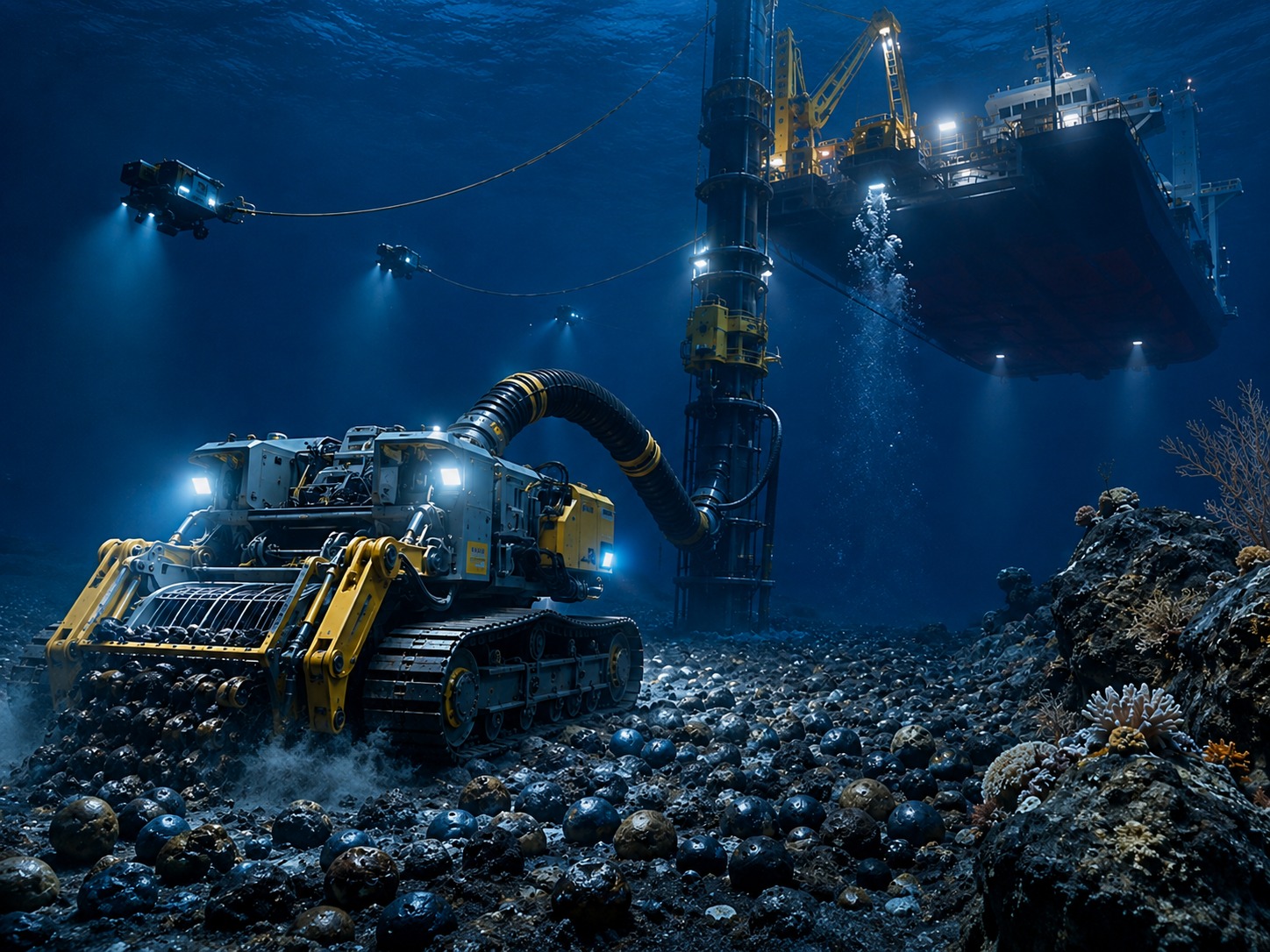

For centuries, humanity has explored the land, the atmosphere and even outer space. Yet one
of the largest unexplored environments on Earth remains beneath the ocean surface.
The deep ocean contains polymetallic nodules, polymetallic sulphides, cobalt-rich crusts and other mineral resources containing materials such as nickel, copper, cobalt and manganese. At the same time, these environments host ecosystems that are still poorly understood. This combination of resource potential, scientific opportunity and environmental sensitivity has led countries around the world to invest in deep-sea exploration, underwater robotics, submersibles and mining machinery.
India is becoming an important participant in this global effort. At the centre of India’s deep-ocean ambitions is Matsya 6000, the country’s flagship human-rated deep-sea submersible being developed under the Samudrayaan Project, itself part of the Government of India’s Deep Ocean Mission.
Matsya 6000 is particularly significant because it represents more than a submarine. It is an
effort to develop indigenous capabilities in human-rated underwater engineering, scientific
exploration, robotics, navigation, life-support systems and extreme-depth operations.
What Is Deep-Sea Mining?
Deep-sea mining refers to the exploration and potential extraction of mineral resources from
the seabed, generally at depths where conventional surface or terrestrial mining technologies
cannot operate.
Three major categories of seabed resources are commonly discussed:
- Polymetallic nodules – potato-sized mineral deposits containing manganese, nickel, copper and cobalt.
- Polymetallic sulphides – mineral deposits associated with hydrothermal vents and underwater volcanic activity.
- Cobalt-rich ferromanganese crusts – mineral-rich crusts that occur on seamounts.
The challenge is not simply finding these resources. The real technological challenge is
reaching several kilometres below the ocean surface, operating machinery under enormous
pressure, collecting material without becoming immobilised on the seabed, transporting it to
the surface and monitoring the environmental consequences.
A modern deep-sea mining system can therefore involve seabed crawler vehicles, collection
mechanisms, pumps, flexible hoses or riser systems, remotely operated vehicles (ROVs),
autonomous underwater vehicles (AUVs), support vessels, sensors and sophisticated
communication and navigation systems.
Why Is the World Interested in Deep-Sea Resources?
The growing demand for critical minerals has increased interest in alternative sources of raw materials. Nickel, cobalt, copper and manganese are important to several industrial and energy technologies.
However, the availability of minerals does not automatically mean that mining them from the ocean is commercially or environmentally viable.
Deep-sea mining remains technically complex, and commercial exploitation has not yet become an established large-scale industry. Environmental impacts, engineering reliability, energy requirements, economics and international regulation remain major questions.
This is why today’s international efforts are focused not only on mining, but also on exploration, scientific research, environmental monitoring and the development of safer machinery.
However, the availability of minerals does not automatically mean that mining them from the ocean is commercially or environmentally viable.
Deep-sea mining remains technically complex, and commercial exploitation has not yet become an established large-scale industry. Environmental impacts, engineering reliability, energy requirements, economics and international regulation remain major questions.
This is why today’s international efforts are focused not only on mining, but also on exploration, scientific research, environmental monitoring and the development of safer machinery.
India’s Deep-Ocean Ambition
India’s Deep Ocean Mission was launched in 2021 with a broad objective: develop
technologies that can enable the exploration and sustainable use of India’s ocean resources.
The mission covers six major areas, including deep-sea mining technology and human submersibles, underwater robotics, biodiversity exploration, deep-ocean surveys, ocean energy and freshwater, and an advanced marine station for ocean biology.
This makes India’s programme considerably broader than a conventional mining project.
The country is simultaneously developing:
Human submersibles → Deep-sea mining systems → Underwater robotics → Oceanographic sensors → Autonomous vehicles → Biodiversity research → Environmental monitoring
Together, these technologies can form the foundation of a future Indian deep-ocean technology ecosystem.
The mission covers six major areas, including deep-sea mining technology and human submersibles, underwater robotics, biodiversity exploration, deep-ocean surveys, ocean energy and freshwater, and an advanced marine station for ocean biology.
This makes India’s programme considerably broader than a conventional mining project.
The country is simultaneously developing:
Human submersibles → Deep-sea mining systems → Underwater robotics → Oceanographic sensors → Autonomous vehicles → Biodiversity research → Environmental monitoring
Together, these technologies can form the foundation of a future Indian deep-ocean technology ecosystem.
Matsya 6000: India’s Most Important Deep-Sea Technology Project
The Matsya 6000 is the most visible technological component of India’s Samudrayaan
Project.
Developed by the National Institute of Ocean Technology (NIOT), Chennai, under the Ministry of Earth Sciences, the submersible is designed to carry three people to depths of up to 6,000 metres.
This is an extraordinary engineering challenge.
At 6,000 metres, the surrounding water exerts pressure hundreds of times greater than atmospheric pressure at the surface. The human occupants therefore need to remain inside a highly engineered pressure sphere capable of protecting them from the external environment.
The personnel sphere of Matsya 6000 has a diameter of approximately 2.1 metres and is made from titanium alloy. It is designed to maintain an internal pressure equivalent to approximately one atmosphere while withstanding the extreme pressure encountered at depth. The pressure hull has been tested to withstand 720 bar, above the pressure expected at 6,000 metres.
Developed by the National Institute of Ocean Technology (NIOT), Chennai, under the Ministry of Earth Sciences, the submersible is designed to carry three people to depths of up to 6,000 metres.
This is an extraordinary engineering challenge.
At 6,000 metres, the surrounding water exerts pressure hundreds of times greater than atmospheric pressure at the surface. The human occupants therefore need to remain inside a highly engineered pressure sphere capable of protecting them from the external environment.
The personnel sphere of Matsya 6000 has a diameter of approximately 2.1 metres and is made from titanium alloy. It is designed to maintain an internal pressure equivalent to approximately one atmosphere while withstanding the extreme pressure encountered at depth. The pressure hull has been tested to withstand 720 bar, above the pressure expected at 6,000 metres.
The Engineering Behind Matsya 6000
Matsya 6000 brings together several advanced technologies.
Its systems include:
The submersible is designed for an operational endurance of around 12 hours, with emergency endurance extending to approximately 96 hours.
These technologies are important because the mission is not simply about transporting three people underwater. The crew must be able to observe, communicate, collect data, conduct experiments and respond to emergencies in an environment where outside assistance may be hours away.
Its systems include:
- Titanium-alloy personnel sphere
- Main ballast system
- Propulsion thrusters
- High-density lithium-polymer battery system
- Syntactic foam for buoyancy
- Underwater acoustic communication
- Emergency ballast and drop-weight systems
- Crew health monitoring through a bio-vest
- Navigation and control systems
- Scientific sensors and payloads
The submersible is designed for an operational endurance of around 12 hours, with emergency endurance extending to approximately 96 hours.
These technologies are important because the mission is not simply about transporting three people underwater. The crew must be able to observe, communicate, collect data, conduct experiments and respond to emergencies in an environment where outside assistance may be hours away.
Matsya 6000 Has Already Passed Major Tests
Matsya 6000 has moved beyond the conceptual stage.
Its design and system integration were completed, followed by wet and harbour trials at the L&T facility in Katupalli near Chennai during January–February 2025. The trials demonstrated systems including flotation, stability, manoeuvrability, power, communication, control and human-support systems.
In February 2025, an integrated demonstration with three people was also successfully conducted in controlled waters.
The programme subsequently faced additional engineering work for the 500-metre shallow-water dive, including the integration of custom syntactic foam. As of March 2026, the Ministry of Earth Sciences reported that the component was still being finalised and that the shallow-water dive was planned after its integration and testing.
The government’s earlier target indicated a first manned 6,000-metre Samudrayaan mission toward the end of 2026, subject to completion of testing and qualification.
Its design and system integration were completed, followed by wet and harbour trials at the L&T facility in Katupalli near Chennai during January–February 2025. The trials demonstrated systems including flotation, stability, manoeuvrability, power, communication, control and human-support systems.
In February 2025, an integrated demonstration with three people was also successfully conducted in controlled waters.
The programme subsequently faced additional engineering work for the 500-metre shallow-water dive, including the integration of custom syntactic foam. As of March 2026, the Ministry of Earth Sciences reported that the component was still being finalised and that the shallow-water dive was planned after its integration and testing.
The government’s earlier target indicated a first manned 6,000-metre Samudrayaan mission toward the end of 2026, subject to completion of testing and qualification.
Matsya 6000 Is Not the Mining Machine — But It Is Critical to Deep-Sea Mining
An important distinction needs to be made.
Matsya 6000 is a human scientific submersible, not India’s primary seabed mining machine.
Its purpose is to take scientists and researchers to extreme depths to conduct exploration and observation.
India is developing a separate deep-sea mining system for collecting polymetallic nodules.
NIOT’s mining system has already undergone mobility and power trials at approximately 5,270 metres in the Central Indian Ocean in 2021. The system is designed for sustainable harvesting of polymetallic nodules from depths of up to about 5,500 metres.
This distinction actually makes the Indian programme more interesting.
Matsya 6000 provides the human exploration capability, while robotic mining systems provide the machinery required for resource collection.
Together, they represent different parts of a larger deep-ocean technology ecosystem.
Matsya 6000 is a human scientific submersible, not India’s primary seabed mining machine.
Its purpose is to take scientists and researchers to extreme depths to conduct exploration and observation.
India is developing a separate deep-sea mining system for collecting polymetallic nodules.
NIOT’s mining system has already undergone mobility and power trials at approximately 5,270 metres in the Central Indian Ocean in 2021. The system is designed for sustainable harvesting of polymetallic nodules from depths of up to about 5,500 metres.
This distinction actually makes the Indian programme more interesting.
Matsya 6000 provides the human exploration capability, while robotic mining systems provide the machinery required for resource collection.
Together, they represent different parts of a larger deep-ocean technology ecosystem.
India's Deep-Sea Mining Machinery
India’s deep-sea mining programme is focused on developing machinery capable of operating under extreme pressure and across difficult seabed terrain.
A typical mining architecture can include:
This combination illustrates why deep-sea mining is closer to a complete underwater industrial infrastructure system than a conventional mining machine.
A typical mining architecture can include:
1. Seabed Mining Vehicle
A tracked or crawler-based vehicle moves across the ocean floor and collects polymetallic nodules.2. Collection System
Mechanical or hydraulic systems gather nodules from the seabed while attempting to minimise the amount of sediment disturbed.3. Crushing and Processing
The collected material may require crushing, separation or processing before transportation.4. Vertical Lifting System
A major challenge is moving material from several kilometres below the surface to a vessel. Riser pipes, flexible hoses, pumps or other lifting technologies can form part of the system.5. Support Vessel
A surface vessel provides power, monitoring, communications, control and material-handling capabilities.6. ROVs and AUVs
Remotely operated and autonomous underwater vehicles can inspect equipment, collect scientific information and monitor environmental conditions.This combination illustrates why deep-sea mining is closer to a complete underwater industrial infrastructure system than a conventional mining machine.
India’s Resource Exploration in the Central Indian Ocean
India already has an exploration area of approximately 75,000 square kilometres allocated by the International Seabed Authority in the Central Indian Ocean Basin.
According to the Ministry of Earth Sciences, sampling has been undertaken to estimate the abundance and grade of polymetallic nodules. The estimated quantity of nodules in the allocated area is around 366 million metric tonnes, with average concentrations reported at approximately 0.14% cobalt, 1.14% nickel, 1.09% copper and 25.2% manganese.
These figures demonstrate the strategic potential of the region, but they should not be interpreted as commercially recoverable reserves. Actual exploitation depends on technology, economics, environmental assessment and the international regulatory framework.
According to the Ministry of Earth Sciences, sampling has been undertaken to estimate the abundance and grade of polymetallic nodules. The estimated quantity of nodules in the allocated area is around 366 million metric tonnes, with average concentrations reported at approximately 0.14% cobalt, 1.14% nickel, 1.09% copper and 25.2% manganese.
These figures demonstrate the strategic potential of the region, but they should not be interpreted as commercially recoverable reserves. Actual exploitation depends on technology, economics, environmental assessment and the international regulatory framework.
International Deep-Sea Mining Initiatives
India is entering a field where several countries and international organisations have already invested decades of research.
International Seabed Authority: Building the Global Framework
The International Seabed Authority (ISA) plays a central role in governing mineral-related activities in the international seabed area beyond national jurisdiction.
ISA has entered into 15-year exploration contracts with multiple contractors covering polymetallic nodules, polymetallic sulphides and cobalt-rich ferromanganese crusts.
However, exploration and commercial exploitation are not the same thing.
The ISA is still working on the regulatory framework — commonly referred to as the Mining Code — for exploitation of mineral resources in the international seabed area.
As of 2026, negotiations remain underway. ISA has stated that completing the Mining Code is a priority and that the framework is considered a prerequisite for future commercial activities in the Area.
The 2026 discussions also include issues such as environmental management, monitoring, test mining, compliance, closure plans and enforcement.
This means the global deep-sea mining race is not merely a technological race. It is also a regulatory and environmental race.
ISA has entered into 15-year exploration contracts with multiple contractors covering polymetallic nodules, polymetallic sulphides and cobalt-rich ferromanganese crusts.
However, exploration and commercial exploitation are not the same thing.
The ISA is still working on the regulatory framework — commonly referred to as the Mining Code — for exploitation of mineral resources in the international seabed area.
As of 2026, negotiations remain underway. ISA has stated that completing the Mining Code is a priority and that the framework is considered a prerequisite for future commercial activities in the Area.
The 2026 discussions also include issues such as environmental management, monitoring, test mining, compliance, closure plans and enforcement.
This means the global deep-sea mining race is not merely a technological race. It is also a regulatory and environmental race.
Japan: Exploring Rare-Earth Mud at Extreme Depths
Japan is pursuing another interesting pathway.
Instead of focusing only on polymetallic nodules, Japanese researchers have been developing technology for extracting rare-earth-rich mud from the seabed around Minamitorishima.
In a 2026 test programme, Japan’s JAMSTEC-led effort worked on connecting and testing a rare-earth mud mining system at approximately 6,000 metres depth. The system included mining equipment, lifting pipes, environmental monitoring instruments and remotely operated equipment.
The Japanese programme demonstrates how deep-sea technology can also be linked to critical-mineral supply security.
Instead of focusing only on polymetallic nodules, Japanese researchers have been developing technology for extracting rare-earth-rich mud from the seabed around Minamitorishima.
In a 2026 test programme, Japan’s JAMSTEC-led effort worked on connecting and testing a rare-earth mud mining system at approximately 6,000 metres depth. The system included mining equipment, lifting pipes, environmental monitoring instruments and remotely operated equipment.
The Japanese programme demonstrates how deep-sea technology can also be linked to critical-mineral supply security.
China: Heavy-Duty Mining Vehicles and Deep-Sea Robotics
China has invested heavily in deep-sea exploration and mining technologies.
Its Pioneer II heavy-duty deep-sea mining vehicle conducted sea trials in 2024, including operations beyond 4,000 metres. During the trials, it collected more than 200 kilograms of deep-sea mineral samples and demonstrated technologies for navigating complex seabed terrain and conducting combined drilling and mining operations.
China is also developing sophisticated mining architectures. Research published in 2025 described a discontinuous polymetallic nodule mining system involving a seafloor collector, flexible hose transportation, buffer storage and high-speed lifting, with modelling for operations at around 5,200 metres.
In addition, China has developed advanced deep-sea ROVs. Its Haiqin system, for example, is designed for 6,000-metre-class operations and has been demonstrated with cameras, robotic arms, sonar and sensors.
These developments highlight the increasing importance of robotics and autonomous systems in deep-sea operations.
Its Pioneer II heavy-duty deep-sea mining vehicle conducted sea trials in 2024, including operations beyond 4,000 metres. During the trials, it collected more than 200 kilograms of deep-sea mineral samples and demonstrated technologies for navigating complex seabed terrain and conducting combined drilling and mining operations.
China is also developing sophisticated mining architectures. Research published in 2025 described a discontinuous polymetallic nodule mining system involving a seafloor collector, flexible hose transportation, buffer storage and high-speed lifting, with modelling for operations at around 5,200 metres.
In addition, China has developed advanced deep-sea ROVs. Its Haiqin system, for example, is designed for 6,000-metre-class operations and has been demonstrated with cameras, robotic arms, sonar and sensors.
These developments highlight the increasing importance of robotics and autonomous systems in deep-sea operations.
Europe: Building More Environmentally Conscious Mining Systems
European research has also focused on developing complete deep-sea mining systems.
The EU-funded Blue Nodules project investigated a highly automated system for collecting polymetallic nodules at depths of up to 6,000 metres.
One of its important technological concepts was the Apollo II subsea harvesting vehicle, designed to collect nodules from the seabed. The system incorporated seabed collection, in-situ processing, vertical transportation and surface handling.
The project also placed significant emphasis on reducing sediment plumes and environmental disturbance.
This is increasingly important because the future of deep-sea mining will depend not only on whether machines can collect minerals, but on whether they can do so while meeting strict environmental requirements.
The EU-funded Blue Nodules project investigated a highly automated system for collecting polymetallic nodules at depths of up to 6,000 metres.
One of its important technological concepts was the Apollo II subsea harvesting vehicle, designed to collect nodules from the seabed. The system incorporated seabed collection, in-situ processing, vertical transportation and surface handling.
The project also placed significant emphasis on reducing sediment plumes and environmental disturbance.
This is increasingly important because the future of deep-sea mining will depend not only on whether machines can collect minerals, but on whether they can do so while meeting strict environmental requirements.
What Does Deep-Sea Mining Machinery Actually Look Like?
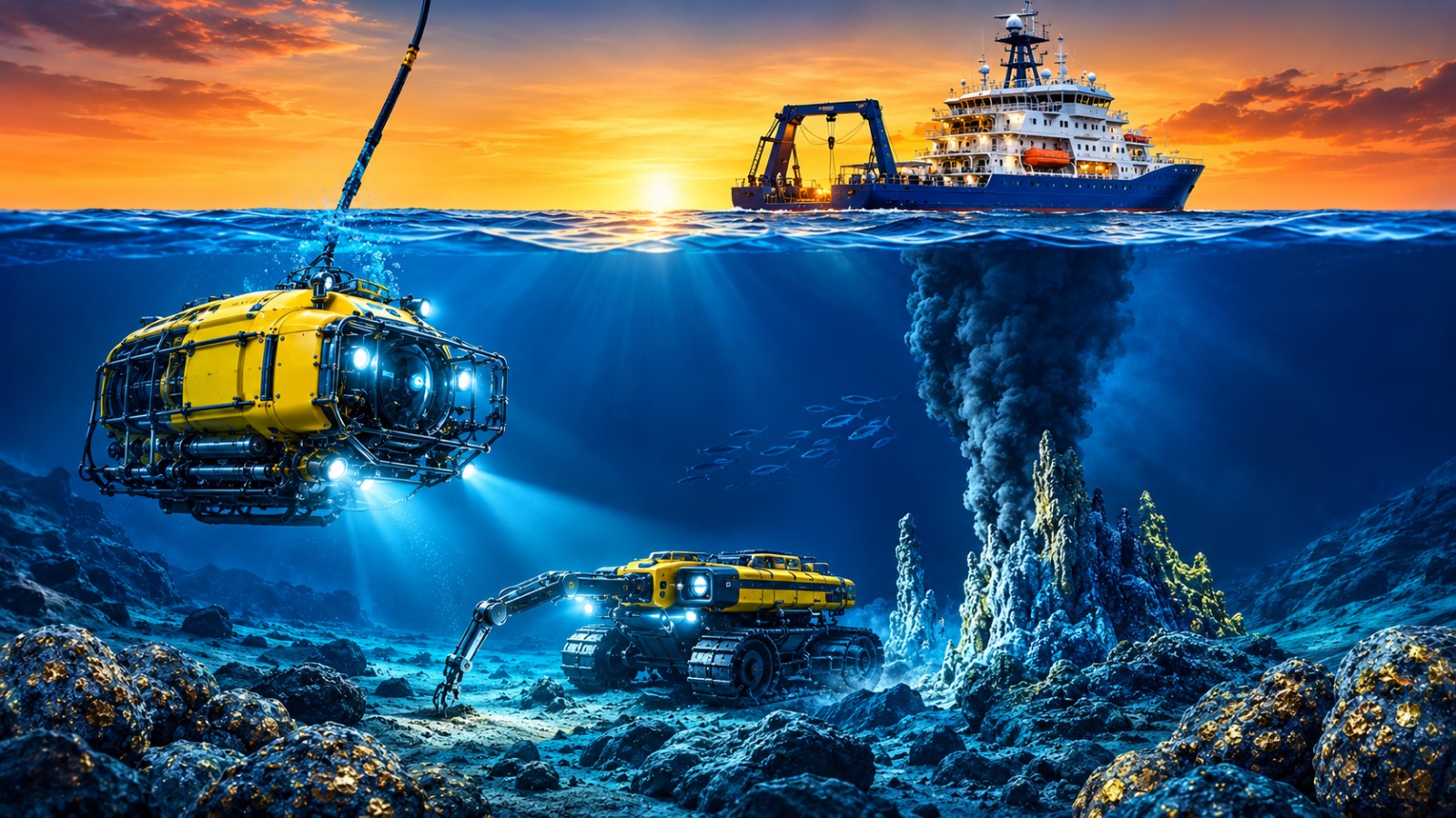
The next generation of deep-sea equipment will likely combine several technologies.
Crawler mining vehicles will travel across the seabed.
Robotic arms and collection heads will gather mineral deposits.
Pumps and riser systems will transport material upward.
ROVs will inspect and maintain equipment.
AUVs will conduct autonomous mapping and surveys.
Sensors and acoustic systems will monitor machines and surrounding ecosystems.
AI and autonomous navigation may allow vehicles to navigate uneven terrain with limited human intervention.
Digital twins and simulation systems can help engineers predict vehicle behaviour and emergency scenarios.
Matsya 6000 itself demonstrates this shift toward advanced integrated systems. Its design incorporates technologies such as a cognitive digital twin for emergency support, underwater acoustic communication and sophisticated crew-monitoring systems.
Crawler mining vehicles will travel across the seabed.
Robotic arms and collection heads will gather mineral deposits.
Pumps and riser systems will transport material upward.
ROVs will inspect and maintain equipment.
AUVs will conduct autonomous mapping and surveys.
Sensors and acoustic systems will monitor machines and surrounding ecosystems.
AI and autonomous navigation may allow vehicles to navigate uneven terrain with limited human intervention.
Digital twins and simulation systems can help engineers predict vehicle behaviour and emergency scenarios.
Matsya 6000 itself demonstrates this shift toward advanced integrated systems. Its design incorporates technologies such as a cognitive digital twin for emergency support, underwater acoustic communication and sophisticated crew-monitoring systems.
The Biggest Challenge: Mining Without Damaging the Deep Ocean
The technological possibilities are impressive, but deep-sea mining also raises serious environmental questions.
Deep-ocean ecosystems can be extremely slow to recover from physical disturbance. Mining vehicles can disturb seabed sediments, create sediment plumes, generate noise and alter the physical environment.
A 2025 study examining a deep-sea polymetallic nodule collector trial at 4,500 metres found that sediment disturbance could travel significant distances under certain conditions. The study highlighted the importance of understanding sediment redeposition and benthic plumes before large-scale operations are considered.
Therefore, the future mining machine cannot simply be:
Bigger + Faster + More Powerful
It must instead become:
More Precise + More Autonomous + More Efficient + More Environmentally Monitored
That is one of the most important engineering challenges facing the industry.
Deep-ocean ecosystems can be extremely slow to recover from physical disturbance. Mining vehicles can disturb seabed sediments, create sediment plumes, generate noise and alter the physical environment.
A 2025 study examining a deep-sea polymetallic nodule collector trial at 4,500 metres found that sediment disturbance could travel significant distances under certain conditions. The study highlighted the importance of understanding sediment redeposition and benthic plumes before large-scale operations are considered.
Therefore, the future mining machine cannot simply be:
Bigger + Faster + More Powerful
It must instead become:
More Precise + More Autonomous + More Efficient + More Environmentally Monitored
That is one of the most important engineering challenges facing the industry.
Why Matsya 6000 Matters So Much for India
Matsya 6000 deserves special attention because its importance extends well beyond one submersible.
It builds human-rated deep-ocean capability
Operating humans safely at 6,000 metres requires expertise in pressure vessels, life support, navigation, propulsion, communications, emergency systems and underwater operations.
It strengthens India’s underwater engineering ecosystem
The technologies developed for Matsya can contribute to other applications such as offshore infrastructure inspection, scientific research, underwater archaeology, marine exploration and defence-related engineering.
It supports deep-sea scientific discovery
The submersible will allow scientists to directly observe environments that cannot be adequately studied only through surface instruments.
It complements robotic mining technology
Human scientists can investigate and understand the environment while robotic systems perform tasks that are too dangerous or repetitive for humans.
It supports India’s Blue Economy ambitions
The Deep Ocean Mission is designed to connect ocean science with technology, resource exploration, biodiversity, energy, freshwater and industrial innovation.
It builds human-rated deep-ocean capability
Operating humans safely at 6,000 metres requires expertise in pressure vessels, life support, navigation, propulsion, communications, emergency systems and underwater operations.
It strengthens India’s underwater engineering ecosystem
The technologies developed for Matsya can contribute to other applications such as offshore infrastructure inspection, scientific research, underwater archaeology, marine exploration and defence-related engineering.
It supports deep-sea scientific discovery
The submersible will allow scientists to directly observe environments that cannot be adequately studied only through surface instruments.
It complements robotic mining technology
Human scientists can investigate and understand the environment while robotic systems perform tasks that are too dangerous or repetitive for humans.
It supports India’s Blue Economy ambitions
The Deep Ocean Mission is designed to connect ocean science with technology, resource exploration, biodiversity, energy, freshwater and industrial innovation.
India’s Opportunity: From Ocean Exploration to Ocean Technology
The greatest opportunity may not be the minerals themselves.
It could be the technology ecosystem created while trying to reach them.
India could develop capabilities in:
This could eventually create opportunities for Indian research institutions, engineering companies, robotics manufacturers, shipyards, software companies and specialised component manufacturers.
It could be the technology ecosystem created while trying to reach them.
India could develop capabilities in:
- Deep-sea robotics
- Human-rated submersibles
- Underwater communication
- Autonomous navigation
- Seabed mapping
- Mining crawlers
- Riser and lifting systems
- Marine sensors
- Pressure-resistant electronics
- Titanium and advanced-material engineering
- Underwater AI
- Environmental monitoring
- Remote inspection
- Ocean data systems
This could eventually create opportunities for Indian research institutions, engineering companies, robotics manufacturers, shipyards, software companies and specialised component manufacturers.
The Road Ahead
Deep-sea mining is still at a developmental stage. The international community has not yet reached the point where large-scale commercial mining in international seabed areas is operating under a completed global exploitation framework.
At the same time, the technological momentum is undeniable.
India is developing Matsya 6000 and its deep-sea mining system. Japan is testing rare-earth mud mining technologies. China is advancing heavy-duty mining vehicles and deep-sea robotics. Europe has developed integrated mining concepts. Meanwhile, the International Seabed Authority continues to work on the rules that will govern potential exploitation in international waters.
The most successful countries may ultimately be those that can combine engineering capability with environmental responsibility.
At the same time, the technological momentum is undeniable.
India is developing Matsya 6000 and its deep-sea mining system. Japan is testing rare-earth mud mining technologies. China is advancing heavy-duty mining vehicles and deep-sea robotics. Europe has developed integrated mining concepts. Meanwhile, the International Seabed Authority continues to work on the rules that will govern potential exploitation in international waters.
The most successful countries may ultimately be those that can combine engineering capability with environmental responsibility.
Conclusion: Matsya 6000 and India’s Journey to the Ocean Floor
Ocean Floor
The race to explore the deep ocean is not simply a race to extract minerals.It is a race to understand one of Earth’s least explored environments and develop the technology required to operate there safely.
For India, Matsya 6000 is a landmark project in that journey.
Its ability to take three people to depths of up to 6,000 metres represents a major step in India’s human-rated deep-ocean capabilities. Alongside the country’s seabed mining machine, underwater robotics, ocean surveys and biodiversity research, Matsya 6000 forms part of a much larger technological programme.
The future of deep-sea exploration will likely belong to systems where humans, robots, AI, advanced materials and environmental science work together.
Matsya 6000 is therefore not just India’s attempt to reach 6,000 metres.
India attempts to build the technological capability to understand, explore and responsibly operate in the deep ocean.
And as countries around the world develop the machines capable of reaching the ocean floor, the next great frontier of engineering may no longer be above us in space — it may be thousands of metres below us in the sea.
Key References
- Ministry of Earth Sciences / Press Information Bureau — Deep Ocean Mission and MATSYA 6000 developments.
- Ministry of Earth Sciences — MATSYA 6000 design, pressure hull and safety systems.
- International Seabed Authority — Exploration contracts and Mining Code development.
- European Commission CORDIS — Blue Nodules deep-sea mining technology project.
- JAMSTEC — Japan’s 6,000-metre rare-earth mud mining system tests.
- China deep-sea mining technology developments and Pioneer II trials.
- Nature Communications — Research on sediment plumes and environmental impacts of nodule mining.
