

From a single school in Gujarat in 1905 to a $1.3-billion-a-year global network — the story of AKDN, the meaning behind its emblem, and the exact segments of the Indian economy its current push is lifting.
By Research Desk | 14 September 2026 | 8-minute read
Few institutions blur the line between faith-rooted philanthropy and hard-nosed economic development as completely as the Aga Khan Development Network (AKDN). Headquartered in Geneva, present in more than 30 countries, and employing around 96,000 people, it channels more than $1.3 billion a year into not-for-profit development work — while simultaneously owning banks, power plants, agribusinesses, hotels and airlines through its for-profit arm. In India, where its presence predates independence, the network is now enjoying a fresh burst of visibility: the first official visit of the new Aga Khan, Prince Rahim al-Hussaini, in September 2026, and a high-profile role in the country’s cultural diplomacy. This article unpacks what AKDN is, where it came from, what its emblem means, and — most importantly — which parts of the Indian economy its current programmes actually move.
1. What Is the AKDN?
The AKDN is a family of private, non-denominational development agencies founded by the Aga Khan. Its stated mission is to improve the quality of life for the most vulnerable people in Asia and Africa — regardless of faith, origin or gender. Although the agencies are secular in operation, they are guided by Islamic ethics of compassion, solidarity and the duty of the fortunate toward the vulnerable. The network works across ten principal agencies, spanning health, education, culture, rural development, habitat, microfinance and private-sector development:
• Aga Khan Foundation (AKF) — grant-making and rural development agency, founded 1967.
• Aga Khan Fund for Economic Development (AKFED) — the for-profit development arm, founded 1984; interests in 70+ project companies employing over 75,000 people in banking, energy, agribusiness, tourism, aviation and media.
• Aga Khan Agency for Microfinance (AKAM) — formalised in 2005 out of two decades of community credit programmes.
• Aga Khan Health Services, Education Services, University, University of Central Asia, Trust for Culture, Agency for Habitat — covering hospitals and clinics, schools and universities, architectural conservation, and disaster-resilient settlement planning.
2. Origins: From an Indian School to a Global Network
The network’s Indian roots run far deeper than its Geneva registration. The Aga Khans — hereditary spiritual leaders (Imams) of the Shia Imami Ismaili Muslims — built schools across Gujarat and Mumbai in the early twentieth century. AKDN has worked in India since 1905, when an Aga Khan School was established in Gujarat. Prince Karim Aga Khan IV, born in Geneva in 1936 and raised partly in Nairobi, succeeded his grandfather as the 49th Imam in 1957 at just 20 years of age. Over the following decade he consolidated the Imamat’s scattered development institutions into a single network, formally established in 1967.
His philosophy, restated throughout his 67-year Imamate, was that development is not charity but the creation of opportunity: “For what the peoples of the developing world seek above all else is hope for a better future.” After his passing in early 2025, his son Prince Rahim al-Hussaini became Aga Khan V — the 50th hereditary Imam and the network’s new chairman. The transition was seamless institutionally: the agencies, the endowment, and the strategy all continued uninterrupted.
3. The Flag Question: What the AKDN Emblem Really Means
AKDN flies no national flag — it is a private, Swiss-registered network that works under the flags of more than 30 host countries, including India. What it does carry is one of the more thoughtfully designed emblems in the development world. In September 2022, under Aga Khan IV’s approval, the network adopted its current mark: a green geometric star built from polygons of three, five and seven sides that form 49 different yet congruent units, interlocking to become one. The number 49 honours Aga Khan IV as the 49th hereditary Imam; the interlocking units symbolise the network itself — many institutions, one interconnected programme spanning the social, cultural and economic dimensions of development. The deeper reading is one of unity in multiplicity: distinct pieces, none able to stand alone, forming a complete whole.
The emblem replaced an older symbol still seen on Aga Khan Foundation materials — a stylised right hand, designed by the celebrated Pakistani artist Zahoor ul Akhlaq, a universal sign of skill, achievement and human care. Together, the two marks trace the network’s identity arc: from a single helping hand to a constellation of interlocking institutions.
4. AKDN in India: More Than a Century of Presence
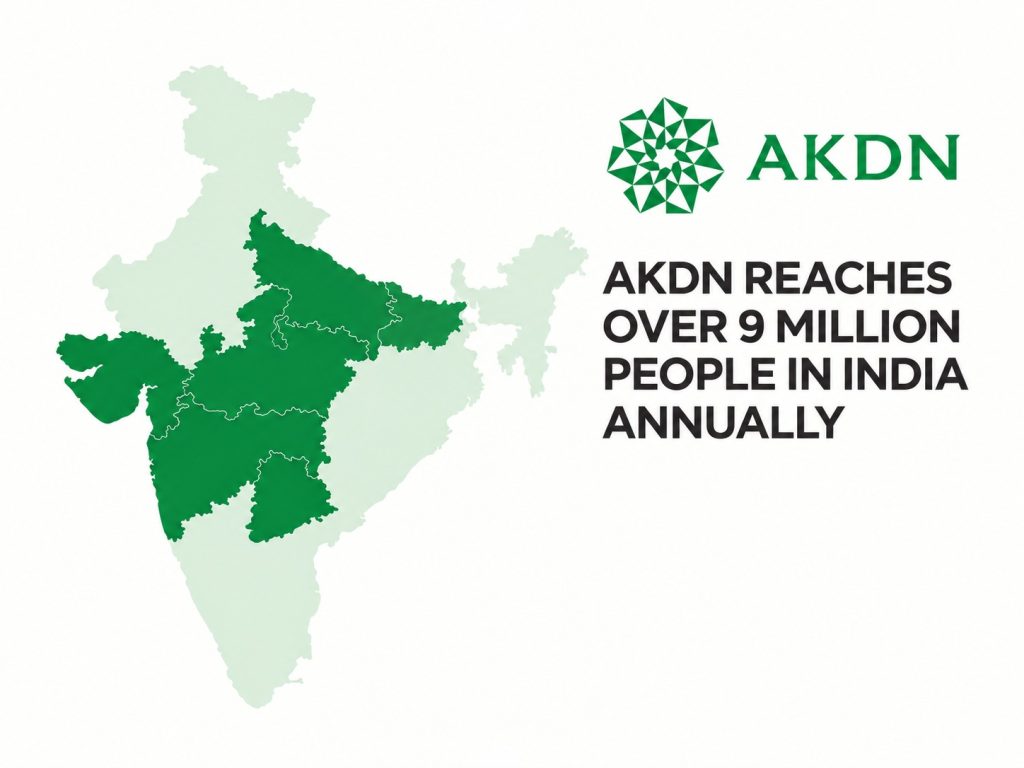
India is the network’s oldest and one of its largest country operations. The Aga Khan Foundation has operated in India since 1978, today working across Bihar, Delhi, Maharashtra, Telangana and Uttar Pradesh and reaching 4.9 million people in 2025. Taken together, AKDN institutions reach over 9 million people in India annually — through schools, health programmes, rural support, sanitation, habitat and financial services.
The 2025 headline numbers for India alone:
• 2.2 million children reached by early childhood development programmes;
• ~390,000 people supported in agriculture and food security;
• ~260,000 people with access to safe drinking water and sanitation;
• ~2 million children, adolescents and pregnant women receiving nutritional screening;
• 2.4 million women supported across all thematic areas;
• 16,500+ people trained through employable-skills programmes in 2024.
5. The New Momentum: Aga Khan V's First Official Visit
September 2026 marked a turning point in the relationship. Aga Khan V visited India from 9 to 15 September — his first official visit since succeeding his father — meeting Prime Minister Narendra Modi in New Delhi on 10 September and holding talks with the Vice President, timed ahead of the BRICS Summit. The visit signals something both sides want: India gains a credible, non-state development partner with unmatched depth in fragile-region institution-building; AKDN gains a government willing to scale its models.
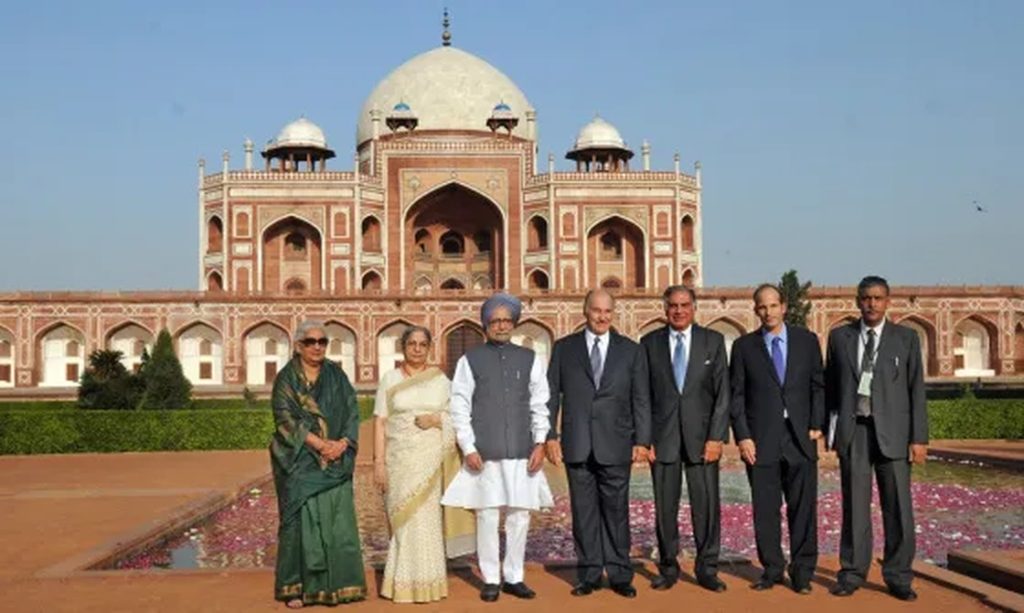
The cultural track ran in parallel. During the AI Impact Summit, world leaders were hosted at the restored Humayun’s Tomb — conservation led by the Aga Khan Trust for Culture — turning a sixteenth-century Mughal mausoleum into the venue for twenty-first-century statecraft. The monument now attracts around two million visitors a year, anchoring the Nizamuddin urban renewal zone alongside Sunder Nursery and the Abdur Rahim Khan-i-Khanan Mausoleum.
6. Which Parts of India's Economy Does AKDN Actually Boost?
Strip away the protocol and the heritage photography, and the India portfolio targets a remarkably specific set of economic segments. This is the analytical heart of the story.
a) Small-ticket finance and MSME credit
AKFED’s single most consequential Indian creation is DCB Bank. From a cluster of small community co-operative societies, AKFED helped engineer a merger into a co-operative bank that became today’s fully commercial DCB Bank — now serving more than 3.2 million active customers through 480 branches, with AKFED and its affiliate holding a combined 14.77% promoter equity. The bank’s core focus is deliberately unglamorous: mortgage, MSME, agri and gold loans with small-ticket lending — precisely the credit segment that feeds India’s micro and small enterprises. Go back further and AKFED also played an instrumental role in launching the Housing Development Finance Corporation (HDFC) in the mid-1970s — meaning the network helped seed modern Indian housing finance itself.
b) Rural agriculture and water security
AKRSP (India) operates in over 3,255 villages, having delivered assured irrigation on more than 75,000 hectares through water harvesting, efficiency and conservation work, alongside scaled solar-energy programmes. Multiplied across hundreds of thousands of farm households, this is direct primary-sector productivity — higher yields, double cropping, climate resilience.
c) Youth skills and the services labour market
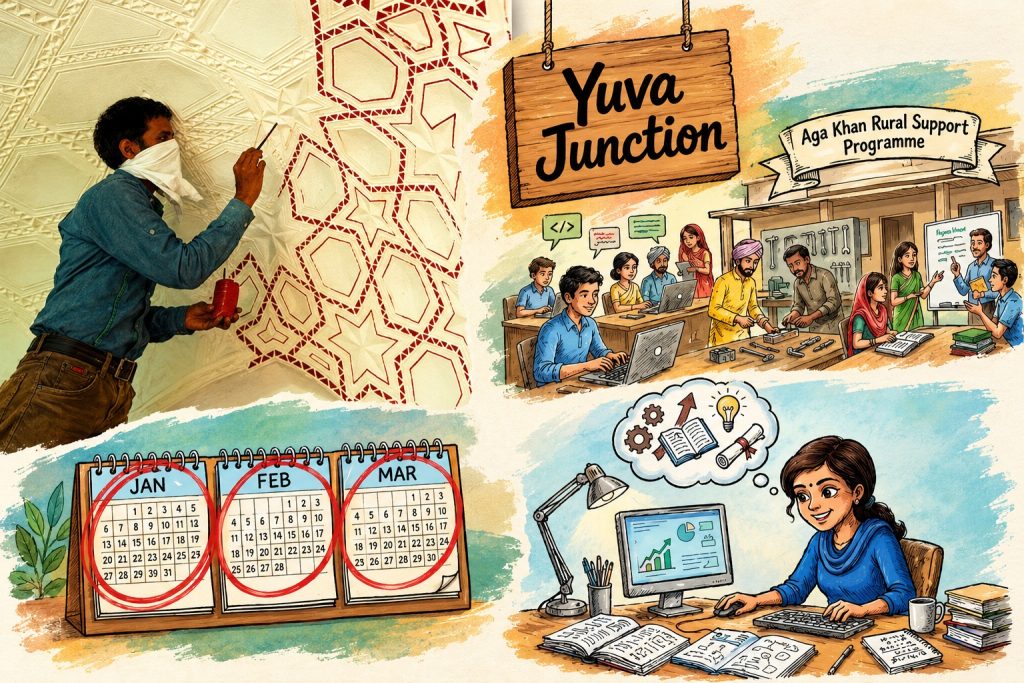
India’s rural youth migration story finds an institutional answer in Yuva Junction, AKRSP’s network of rural skills and entrepreneurship centres. Youth are trained in computing, nursing and retail, connected to employers — retail chains, call centres, construction firms — and guided to government employment schemes. In 2024 alone, over 16,500 people used AKF’s employable-skills training or support services.
d) Women's economic participation
With 2.4 million women supported across thematic areas in 2025 — through employment and life-skills training, microenterprise support, finance access, and women’s and youth collectives that can tap government schemes — AKDN is quietly expanding the female labour force and the rural microenterprise base, the segment where every rupee of income has the highest multiplier effect on household welfare.
e) Sanitation, habitat and the construction economy
AKDN agencies have helped build over 170,000 sanitation units in India, supplying materials, expertise, training and construction management, alongside drinking-water access. Beyond public health, this creates durable local construction employment and a working compendium of sanitation technologies adapted to Indian urban and rural conditions.
f) Heritage and tourism economics
Two million annual visitors to Humayun’s Tomb mean jobs, vending, guiding and hospitality income in Nizamuddin — conservation converted into a tourism-economy engine in the heart of Delhi. AKTC’s model of pairing award-winning conservation with urban renewal is, in effect, an economic development strategy wearing cultural clothes.
7. The Bottom Line
The Aga Khan Development Network is a hybrid without real parallel: a faith-anchored, privately funded network that mixes an annual $1.3 billion philanthropic budget with a for-profit arm that owns banks and power plants. Its emblem — 49 interlocking polygons — is an accurate visual thesis: many institutions, one interconnected programme. In India, its newest chapter is less about new money than about scale and signal: a first official visit, a heritage stage at the AI Impact Summit, and a programme portfolio aimed squarely at the segments where India needs private, patient capital most — MSME credit, farm productivity, youth skilling, women’s economic participation, sanitation-linked construction and heritage tourism. Few international actors can claim to have helped build both DCB Bank and the revival of Humayun’s Tomb. That breadth — from banking halls to Mughal monuments — is what makes the AKDN’s India story worth watching.
“The engagement of the Imamat in development is guided by Islamic ethics, which bridge faith and society. It is on this premise that I established the Aga Khan Development Network.” — Aga Khan IV, 2004
Image Credits & Sources
https://www.tatler.com/article/who-is-the-new-aga-khan
https://ucentralasia.org/resources-and-media/news/2022/september/new-akdn-logo-and-website
https://the.akdn/en/resources-media/resources/publications/akdn-india-brochure
https://ismailimail.blog/2014/12/22/museum-planned-at-humayuns-tomb-by-aga-khan-trust-for-culture/
https://www.tatatrusts.org/our-stories/article/humayuns-tomb-restoration
https://the.akdn/India AKDN India country overview: https://the.akdn/en/where-we-work/south-asia/india AKDN global overview: https://the.akdn/en/about-us
Research compiled September 2026 from AKDN official publications, the Aga Khan Foundation India country pages, DCB Bank corporate disclosures, Tata Trusts and media coverage of Aga Khan V’s India visit. Figures reflect the most recent published data (2024–2026). Images are reproduced for editorial/research purposes with source attribution; rights remain with their respective owners.
All information, images, and other content presented here come from various sources on the internet and are used for informational purposes only. We do not claim ownership of third-party content unless otherwise stated.
